
Lever Harp vs. Pedal Harp: How to Choose the Right First Harp
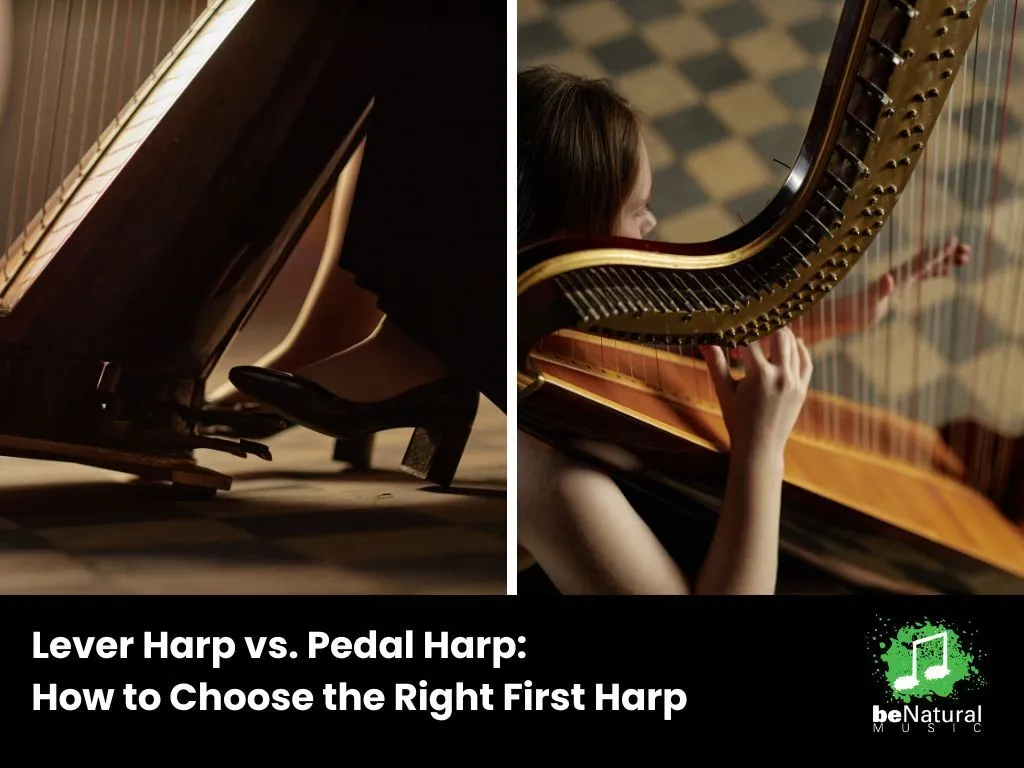
The difference between a lever harp and a pedal harp comes down to how each one changes pitch, and that single mechanical choice shapes the music your child can play, what the instrument costs, and how easily it travels.
Lever harps use small levers flipped by hand, suit folk, Celtic, early music, and arranged classical, and fit in most cars. Pedal harps use seven foot pedals, play the full classical and orchestral repertoire as composers wrote it, and travel in a van with a harp cart. Most students begin on a lever harp, and many stay with it through advanced grades.
| Feature | Lever Harp | Pedal Harp |
|---|---|---|
| How pitch changes | Hand-flipped levers, one per string | Seven foot pedals, each controlling one note across every octave |
| Height | About 3 to 5 feet | About 6 feet |
| Weight | Varies with size, up to roughly half a pedal harp | Roughly 80 pounds |
| Strings | Commonly 24 to 36, with smaller and larger models available | 47 on a concert grand, 40 on the smallest models |
| Keys available | Set by tuning, commonly reaching 4 sharps and 3 flats | Every key, fully chromatic |
| Suits | Folk, Celtic, early music, arranged classical | Classical, orchestral, jazz, musical theater |
| Transport | Fits most cars | Van or truck, plus a harp cart |
| Typical purchase price | About $1,500 to $10,000 | About $8,000 to start, $12,000 to $20,000 for student models |
Both instruments are complete in their own right, and professional harpists build full careers on each. The choice follows your child’s musical goals.

Which Harp Fits Your Child?
Goals make the best starting point, since repertoire drives most of this decision.
A lever harp fits when your child is drawn to Celtic, folk, or early music, when you want an instrument that travels easily to harp lessons and recitals, when you are finding out how the harp holds their interest, or when budget guides the decision.
A pedal harp fits when your child already plans to play in an orchestra, when they want to perform classical works exactly as written, or when they are heading toward conservatory study.
A lever harp chosen with a pedal harp in mind fits when the long-term goal is orchestral or classical playing and a pedal harp sits outside this year’s budget. That path works well with one adjustment, which the planning section below covers.
The American Harp Society also suggests weighing the age and size of the player alongside your transport and space situation, since a smaller harp often proves more comfortable and more enjoyable for a young beginner.

How Each Harp Changes Pitch
Harp strings are laid out like the white keys on a piano, running A, B, C, D, E, F, and G. Sharps and flats come from shortening a string while you play, and this is where the two instruments differ. Our guide to music theory for beginners covers how sharps and flats work if that idea is new to your family.
Levers Work One String at a Time
Each string on a lever harp has a small lever near the top. Flipping a lever presses against the string, shortens its vibrating length, and raises the pitch by one semitone. A harp tuned to E-flat gives your child a working set of keys, commonly reaching four sharps and three flats.
Changing keys means reaching up with the left hand and flipping the levers for the strings that need to move. Harpists plan these changes into rests and sustained notes, which becomes part of how they read and prepare a piece.
Pedals Work One Note Across Every Octave
A pedal harp has seven pedals at the base, one for each letter name. Each pedal connects to a rod inside the column, and that rod turns small brass discs at the neck of the harp. Turning those discs shortens every string of that letter name at once, so one movement of the C pedal changes all the C strings together. The mechanism that makes this work runs to more than 1,400 parts.
Each pedal has three positions: flat at the top, natural in the middle, and sharp at the bottom. Feet handle the pitch changes, so both hands stay on the strings throughout a piece.
What This Means While Playing
Music that stays in one or two keys sits comfortably on a lever harp, and skilled players perform sophisticated repertoire this way. Music that modulates quickly, which describes much of the Romantic and modern classical literature, suits the pedal system. That is the practical reason orchestras use pedal harps.
Size, Weight, and Getting to Lessons
Lever harps stand roughly three to five feet tall, and a large one weighs about half of what a pedal harp weighs. Smaller lap models are lighter still and sit on a table or stool. Either size fits in most cars, which keeps the trip simple whether your family is heading to our Cupertino studio or our Santa Cruz studio.
Pedal harps stand about six feet tall and weigh around 80 pounds. Moving one calls for a van or truck, a padded cover, and a harp cart. Families who own pedal harps usually keep the instrument in one place and plan transport around performances, which is worth thinking through if your child enjoys playing at student recitals.
Repertoire, Strings, and Tone
Repertoire is the clearest guide to which harp suits your child, so it deserves a close look.
Music That Suits the Lever Harp
Lever harps carry the full Celtic and folk tradition, including jigs, reels, and airs. They also handle early music, hymns, contemporary pieces written for lever harp, singer-songwriter accompaniment, and a large library of classical arrangements. Their warm, intimate tone suits solo playing, small ensembles, and chamber settings.
Many professional harpists work exclusively on the lever harp, performing at weddings, folk festivals, recording sessions, and therapeutic settings.
Music That Suits the Pedal Harp
Pedal harps open the complete classical repertoire, including Mozart, Debussy, Ravel, and the orchestral literature. Their fuller, more powerful sound carries in concert halls and over a full orchestra. That same chromatic flexibility suits jazz, musical theater, film scoring, and contemporary composition.
Celtic ornaments sit especially naturally on a lever harp, where the lighter string tension suits quick decoration, so harpists devoted to that repertoire often keep a lever harp alongside a pedal harp.
Strings and Sound
Lever harps commonly use nylon strings, which give a bright, clear tone, hold up well, and cost less to replace. Some players choose gut or carbon fiber for a rounder sound and a heavier pull.
Pedal harps use a mix along the range. The lowest strings are wound copper or steel; the middle range uses gut, which produces the instrument’s signature warm, resonant sound; and the highest strings are usually nylon. Gut responds to shifts in temperature and humidity, so pedal harp owners watch room conditions and plan for regular string replacement.
What Each Harp Costs
Cost shapes this decision for most families, and the gap between the two instruments is wide.
Purchase Prices
Harp dealers commonly list quality lever harps from about $1,500 for a solid beginner instrument up to around $10,000 for a professional model. Harps with fewer strings sit at the lower end. You can also buy a lever harp with levers on only some strings and add the rest later, which brings the entry cost down.
Entry-level pedal harps commonly start around $8,000. Student models typically run $12,000 to $20,000, and professional instruments go well beyond that.
Renting
Renting is how most families start. A rental puts a proper instrument in your home while you find out how practice fits your week. The American Harp Society notes that harps can be rented from teachers, dealers, and other harpists, and that some manufacturers and dealers run rent-to-own programs, which spread the cost across months and let early payments count toward a purchase.
Families weighing the wider investment may find our thoughts on whether music lessons are worth it useful, and we also offer scholarships for students who need support.
Ongoing Care
Lever harps need regular tuning, occasional string replacement, and care of the wood and levers. Annual costs commonly land in the low hundreds of dollars.
Pedal harps have those same needs plus periodic regulation by a specialist technician. The American Harp Society puts the string tension bearing on a pedal harp soundboard at around 2,000 pounds, and that load, combined with the mechanism described earlier, is why regulation matters. Annual costs commonly run several hundred dollars and up.
Graded Exams and Long-Term Progress
Families working toward graded exams have a clear path on either instrument.
The Associated Board of the Royal Schools of Music, known as ABRSM, offers two separate harp qualifications, one for pedal harp and one for non-pedal harp, and both run through Grade 8. A student can complete the entire graded path on a lever harp.
String count matters for repertoire. ABRSM notes that its non-pedal pieces from Grade 3 onward are generally written for instruments with at least 34 strings, and its pedal pieces from Grade 4 onward are written for instruments with at least 46 strings. Grades 1 and 2 sit below that threshold and work comfortably on smaller harps, and ABRSM publishes an Adapted Instruments Policy covering instruments suited to younger and smaller beginners.
A 34-string lever harp is therefore a sensible target for a student planning to work through the grades, and a smaller harp is a comfortable place to begin.
Planning Ahead if the Pedal Harp Is the Goal
The two instruments use different hand techniques, and pedal harp strings ask for a stronger pull. Students aiming for pedal harp benefit from building that hand strength early.
Two approaches work well here. Learning on a pedal harp from the start is the most direct route. Where that sits outside the budget, choose a lever harp built at concert tension with the wider string spacing of a pedal harp, which makers including Lyon and Healy and Salvi produce, then tell your teacher the long-term goal so lessons build pedal harp technique alongside the fundamentals. Our guide to what happens in a private music lesson explains how those conversations shape a lesson plan.
Harpists generally find the move from pedal harp technique to lever harp technique straightforward, which is worth knowing as you plan the order.

Other Harps You Might Hear About
Levers and pedals cover most of what students encounter, and a few other harps come up in conversation.
- Wire-strung harps use metal strings played with the fingernails, which gives a bell-like tone, and they carry the older Gaelic tradition.
- Double-strung lever harps have two rows of strings side by side, each row with its own levers, which opens up echo effects and two-handed melody work.
- Triple-strung harps place a row of sharps and flats between two rows of natural notes and use no levers at all.
- Historical harps are reproductions of instruments from earlier centuries, often with narrower spacing between strings.
These suit students with a specific interest in that repertoire. For most families, the lever and pedal comparison covers the decision.
Start Harp Lessons Today!
Be Natural Music teaches students across Cupertino and Santa Cruz, and our teachers walk families through this exact decision every term. Lessons cover classical alongside jazz, rock, and contemporary styles, and students perform together at regular showcases.
Families comparing instruments often read our bass guitar and regular guitar comparison as well, since the same goal-first thinking applies.
Whichever harp your child starts on, our teachers build the fundamentals first: hand position, finger independence, music reading, and musical expression. Those skills carry across both instruments, which keeps the door open as goals develop.
Ready to talk it through? Explore our harp lessons or get in touch, and we will help you match the instrument to your child’s goals.
