
Are Music Lessons Worth the Money? An Honest Breakdown for Parents
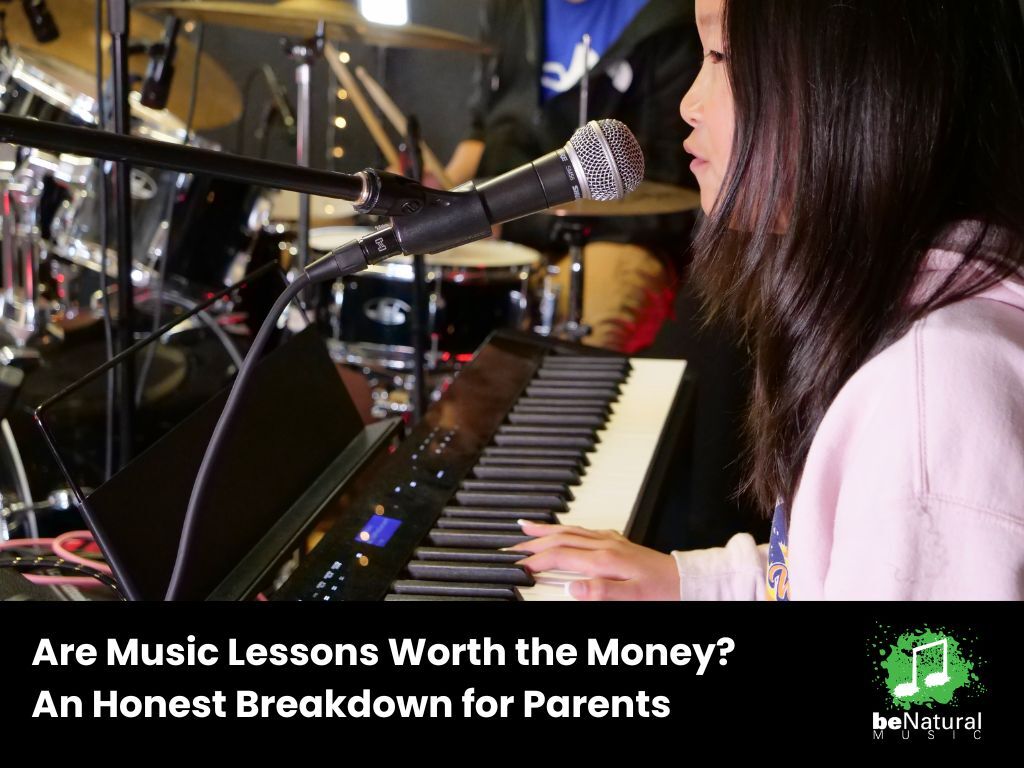
Why Music Lessons Earn Their Spot on a Jam-Packed Kid Calendar?
For many Cupertino parents, the worry is real: cost, practice time, academic pressure, and whether lessons will actually build confidence rather than become “one more thing.”
That’s why finding the right fit matters. At Be Natural Music, we help families turn lessons into a meaningful investment through supportive instruction, real feedback, and programs designed to help kids grow musically, socially, and emotionally. Don’t just add another activity; choose one that can shape your child’s future.
Here’s a quick summary of what the evidence shows:
| Benefit | What the Research Says |
|---|---|
| Academic performance | Music students score an average of 31 points higher on SAT verbal and 23 points higher on SAT math |
| Brain development | Even one hour of weekly practice for a few months can alter brain architecture |
| Emotional growth | Music builds emotional regulation, stress relief, and self-expression |
| Social skills | Group music settings build teamwork, confidence, and peer connection |
| Life skills | Discipline, focus, and goal-setting transfer to school and beyond |
If you’re a parent in Cupertino, you already know the pressure is real. Between school performance expectations at top-tier Cupertino Union School District (CUSD) schools like Faria Elementary and Kennedy Middle, competitive extracurriculars, and the high-achieving tech culture that comes with living in the shadow of Apple Park, finding activities that genuinely support your child’s growth, not just their college resume, matters.
Music lessons are one of those rare investments that pay off on multiple levels at once: intellectually, emotionally, and socially.
But Cupertino parents reasonably want an honest, data-driven answer before committing. Not a sales pitch. Not vague promises about “lifelong benefits.”
This guide gives you exactly that, a clear, research-backed breakdown of what music lessons actually deliver, what they cost, and how to find the right fit for your child right here in the heart of Silicon Valley.
I’m Matt Pinck, founder of Be Natural Music and a music educator with over 25 years of experience helping kids and adults discover their voice through music, and I’ve seen that one of the main questions is: Are music lessons worth it? This is a very good question to ask before you invest. Let’s walk through everything you need to know to make a confident decision for your family.

Are Music Lessons Worth It for Intellectual, Emotional, and Social Growth?
When we look at the return on investment (ROI) for music lessons, it is helpful to look past the physical instrument itself. Your child isn’t just learning to press keys or pluck strings; they are engaging in a comprehensive mental workout.
Neuroscientists have demonstrated that playing an instrument acts as “brain fitness.” It engages practically every area of the central nervous system at once, particularly the visual, auditory, and motor cortices. This disciplined, regular practice strengthens the corpus callosum, the bridge connecting the left and right hemispheres of the brain, allowing messages to travel more quickly and via more diverse routes.

This neurological development directly translates into enhanced executive functioning skills. These are the cognitive processes that help children plan, focus, remember instructions, and balance multiple tasks. According to research highlighted in The Benefits of Learning Music, these foundational skills build a pathway for lifelong learning.
When you enroll your child in lessons, you can Expect Private Music Lessons to nurture their fine motor skills, boost their physical coordination, and instill a quiet, steady confidence that carries over into every other aspect of their lives.
Are Music Lessons Worth It for Cupertino Students’ Cognitive and Academic Gains?
In a highly academic community like Cupertino, parents often look for activities that support school performance. The academic gains associated with music education are well-documented. On average, students who participate in high-quality music programs score significantly higher on the SAT verbal and math sections compared to their non-musical peers.
This correlation is not a coincidence. Music is inherently mathematical. It requires understanding fractions through rhythms, recognizing complex auditory patterns, and managing spatial-temporal reasoning. When children learn to read sheet music, they are essentially learning a rich, expressive foreign language. This dual focus on mathematical structure and linguistic interpretation accelerates cognitive development during critical early years.
As noted in Are Music Lessons Worth the Cost?, the cognitive benefits of early music training persist well into adulthood. By focusing on Nurturing Kids Musical Talent today, parents help their children build a resilient framework for complex problem-solving that will serve them through their school years near De Anza College, Lawson Middle, and Monta Vista High, and into their future careers in the tech sector.
Emotional Resilience and Social Connection in Group Settings
While the intellectual benefits are incredible, the emotional and social impacts are often what Cupertino parents cherish most. Today’s local youth face unprecedented levels of academic and social stress. Music offers an active, creative outlet, a form of mindful meditation where students can channel their feelings and find healthy stress relief.
In our Cupertino community, keeping balance is key. Participating in Kids Music Classes provides a supportive, low-pressure environment where mistakes are simply part of the creative process. This builds emotional regulation and resilience. When a child struggles with a difficult passage on the guitar or piano, works through the frustration, and finally masters it, they learn that perseverance brings joy.
Furthermore, when music lessons expand into group settings, such as our rock and jazz ensembles on Stevens Creek Boulevard, the social benefits multiply. Students learn the art of peer collaboration, active listening, and compromise. Playing in a band teaches kids how to support one another, manage performance anxiety together, and share the pride of a live performance.
Private Lessons vs. YouTube: Why Does Personalized Feedback Matter?
With thousands of hours of free tutorials available online, many tech-savvy Cupertino parents ask: Why should we invest in professional music lessons when our child can just learn from YouTube?
While online videos are excellent tools for inspiration and learning basic chord shapes, they lack the interactive elements necessary for true mastery: accountability, structured progression, and real-time feedback.
Without a teacher’s watchful eye, a beginner can easily develop physical habits that limit their progress. Poor posture, tense hand placement, or incorrect hand angles can lead to physical strain and make advanced techniques incredibly difficult to learn later on. Unlearning these bad habits can take years.
A professional teacher provides:
- Customized Pacing: Adapting the curriculum to your child’s unique learning style and interests.
- Immediate Correction: Catching technical issues before they become ingrained muscle memory.
- Accountability: Creating a supportive structure that motivates consistent weekly practice.
- Emotional Safety: Offering a judgment-free space where shy students feel safe asking questions and taking creative risks.
When evaluating Private Music Teacher Qualities, look for instructors who balance technical discipline with fun. Combining structured home practice with personalized guidance is one of the best Five Ways to Get the Most Out of Music Lessons.
Counting the Cost: Are Music Lessons Worth It for Busy Cupertino Families?
Every family must weigh their extracurricular choices carefully, balancing both time and household budgets. In Cupertino, parents often compare music lessons to competitive sports leagues, STEM camps, or language tutoring.
To help put the commitment into perspective, here is a qualitative look at how different activities compare:
| Activity Type | Focus Areas | Primary Long-Term Benefits | Flexibility & Pacing |
|---|---|---|---|
| Private Music Lessons | Individualized technique, personal expression, theory | Cognitive growth, stress relief, lifelong artistic skill | Highly flexible; tailored entirely to the student’s pace |
| Group Band Classes | Peer collaboration, live performance, rhythm | Teamwork, social confidence, stage presence | Moderately flexible; relies on collaborative group dynamics |
| Youth Sports Leagues | Physical fitness, competitive teamwork, strategy | Physical coordination, athletic discipline, competitive drive | Fixed schedules; highly dependent on seasonal league timelines |
| Academic Tutoring | Subject mastery, test prep, study skills | Grade improvement, specific academic confidence | Structured; focused on immediate academic benchmarks |
To make music education accessible to all families in our community, we offer various program options, flexible scheduling, and financial support through Scholarships for families who qualify.
If you are exploring local options, Cupertino is home to fantastic music resources. Families often look at local programs to see the vibrant musical landscape available in our neighborhoods. At Be Natural Music, we complement traditional classical foundations by focusing on real-world rock and jazz band performance, giving kids a unique, modern outlet to apply their skills.
Finding the Right Fit: Best Age to Start and Instrument Selection
A common question parents ask is: When is my child actually ready to start?
While children develop at their own pace, there are general developmental windows where certain instruments become much easier to learn:
- Ages 5 to 7: This is often the ideal window to consider the Best Age to Start Piano Lessons. The piano provides a clear, visual layout of music theory and helps develop fundamental hand-eye coordination without requiring complex physical grips.
- Ages 8 to 10: This is generally the Best Age to Start Guitar Lessons or bass. By this stage, children have developed the finger strength and hand size necessary to press down steel or nylon strings comfortably.
The most important factor, however, is your child’s genuine interest. If a child is drawn to the drums, forcing them onto the violin can lead to frustration. Let your child listen to different styles of music, attend local concerts, and see which sounds they naturally gravitate toward.
Investing in Your Child’s Creative Future
Deciding whether music lessons are worth it comes down to what you want for your child’s future. If you are looking for a quick, effortless hobby, music might feel like a challenge. But if you want to give your child a lifelong gift, one that builds their brain, helps them manage stress, teaches them the value of hard work, and connects them with a supportive community, then music lessons are worth every single moment.
At Be Natural Music, we are proud to be a part of the rich Music School California community, offering a warm, nurturing space where Cupertino kids can discover the pure joy of making music together. Whether they are taking their very first steps on an instrument or preparing to take the stage at local community events like the Cupertino Cherry Blossom Festival or Memorial Park amphitheater, we are here to support them every step of the way.
For a complete look at local programs, schedules, and tips for Cupertino families, explore our Guide Music Lessons Cupertino 2026.
Wondering if music lessons are worth it for your child? Come see the value firsthand. Start your child’s musical journey with Be Natural Music classes and help them build confidence, creativity, and skills that last.
