
Music Theory for Beginners: The 6 Basics That Make Everything Click
- Why Does One More Activity Feel Like Both an Opportunity and a Risk?
- What Makes Music Theory the Ultimate Brain and Emotional Workout for Cupertino and Santa Cruz Students?
- 1. Pitch and the 12-Note Alphabet: Building Confidence from the Ground Up
- 2. Reading Sheet Music: A Music Theory Guide to Clefs
- 3. Intervals: The Distance Between Notes and the Power of Active Listening
- 4. Scales and Keys: The Roadmap of Music Theory
- 5. Chords and Harmony: Building Blocks of Songwriting and Collaboration
- 6. Rhythm, Meter, and Tempo: Finding the Groove and Relieving Stress
- Are Music Lessons Worth It, and Why Do Parents Choose Be Natural Music?

Why Does One More Activity Feel Like Both an Opportunity and a Risk?
In Cupertino and Santa Cruz, where academics move fast, and calendars fill up fast, parents often wonder whether music lessons will truly help their child grow or simply add more pressure. Your child needs a creative space where learning feels energizing, not overwhelming.
At Be Natural Music, we believe music shouldn’t feel like another high-pressure test. When we teach music theory for beginners, we aren’t asking kids to memorize dry rules. We are giving them a creative outlet that builds emotional resilience, sharpens intellectual focus, and fosters deep social connections right here in our South Bay community.
The 6 basics every beginner learns with us:
- Pitch — the 12 notes that form the foundation of all Western music
- Reading Music — translating symbols on a staff into real, expressive sounds
- Intervals — the emotional distance between notes that creates tension and release
- Scales and Keys — the roadmap that helps young musicians improvise and jam
- Chords and Harmony — how notes combine to express complex feelings
- Rhythm, Meter, and Tempo — finding the groove and locking in with a band
If you’re driving down Stevens Creek Boulevard or Water Street. Doing chores or picking up your kids from school, you know how competitive the California environment can be. Music theory isn’t about adding more homework; it’s the grammar of self-expression. It helps young musicians play with confidence, collaborate with peers, and find their unique voice.
I’m Matthew Pinck, founder of Be Natural Music. With over 25 years of experience teaching jazz, rock, and blues, I’ve helped hundreds of South Bay students discover that music theory isn’t just understandable, it’s the key to creative freedom. In this guide, we’ll break down the six pillars of music theory and show you exactly why investing in your child’s musical education pays lifelong dividends.

What Makes Music Theory the Ultimate Brain and Emotional Workout for Cupertino and Santa Cruz Students?
When Cupertino and Santa Cruz’s parents hear “music theory,” they often worry it will feel like an extra AP Calculus class. But at Be Natural Music, we teach theory as a descriptive tool, not a rigid set of rules. It is a language that helps kids label and share the musical patterns they already love hearing in their favorite songs.
For students navigating the academic rigor of the Cupertino Union School District, this kind of knowledge offers a unique intellectual and emotional balance. It exercises the logical left brain through mathematical structures like Western Tonal Harmony, while simultaneously giving the creative right brain a safe space to process stress and express complex emotions.
Understanding how sounds make us feel is a core part of this journey. When our students play together, they learn to balance these two primary harmonic forces:
| Harmony Type | Description | Emotional Feel | Student Application |
|---|---|---|---|
| Consonant Harmony | Stable, sweet, and pleasing intervals that transition smoothly. | Resolution, peace, and stability. | Finding calm and focus after a long school day. |
| Dissonant Harmony | Unstable intervals that create tension and clash. | Drama, suspense, and urgency. | Learning to navigate and resolve academic or social stress. |
By learning to balance consonance and dissonance, young musicians learn that tension is just a stepping stone to resolution, a powerful life lesson for any South Bay teen. To explore the academic history of these concepts, see the Music Theory I resource.
1. Pitch and the 12-Note Alphabet: Building Confidence from the Ground Up
The first pillar of music theory is pitch, which refers to how high or low a sound is. While the human ear can hear a massive range of frequencies, Western music organizes these sounds into a simple, repeating system of 12 unique notes.
These notes are named after the first seven letters of the alphabet: A, B, C, D, E, F, and G.
Once you reach G, the alphabet starts over at A, but at a higher pitch. This distance between one note and its next repeating letter is called an octave.
But what about the other five notes? They are represented by the black keys on a piano, using symbols called sharps and flats:
- Sharp (#): Raises a note by one semitone (a half step).
- Flat (b): Lowers a note by one semitone (a half step).
Because these notes sit between the natural letters, they can have two names. For example, the black key between C and D can be called C-sharp (C#) or D-flat (Db). These are known as enharmonic equivalents; they sound exactly the same, but their written names change depending on the key of the song.
At Be Natural Music, we help students in Cupertino and Santa Cruz connect abstract pitches to their own voices and instruments, building the self-assurance they need to perform live. You can explore how these pitches relate to different singing voices in our guide on Vocal Ranges. To dive deeper into the physics of how pitch works, check out Chapter 1.1 Pitch.
2. Reading Sheet Music: A Music Theory Guide to Clefs

Now that we know the notes, how do we write them down? Written music uses a five-line grid called the staff.
To tell us which notes belong on which lines, we place a symbol called a clef at the very beginning of the staff. The two most common clefs are:
- Treble Clef (G-Clef): Used for higher-pitched instruments like the violin, flute, guitar, and the right hand of the piano. It wraps around the second line from the bottom, designating it as the note G.
- Bass Clef (F-Clef): Used for lower-pitched instruments like the bass guitar, cello, trombone, and the left hand of the piano. The two dots of the bass clef bracket the second line from the top, designating it as the note F.
When notes go too high or too low to fit on the standard five lines, we use short, temporary lines called ledger lines to extend the staff.
Learning to read these symbols is incredibly empowering for kids, giving them a tangible sense of achievement outside of school grades. If your child is learning piano or a classical instrument, check out our step-by-step breakdown on How To Read Sheet Music. If they are picking up the guitar to join one of our rock bands, they will also love our practical guide on How To Read Guitar Tabs.
3. Intervals: The Distance Between Notes and the Power of Active Listening
An interval is simply the measurement of the distance between two pitches. Understanding intervals is like learning the measurements of building blocks; it helps us understand how scales and chords are constructed.
The smallest interval in Western music is the semitone (or half step). On a guitar, this is the distance of one fret; on a piano, it is the distance from a white key to the very next black key. Two semitones make a whole tone (or whole step).
Intervals are named by their size and quality. For example:
- Minor Third: Consists of three semitones (think of the sad, classic opening of “Hey Jude”).
- Perfect Fifth: Consists of seven semitones (the powerful, stable sound of a guitar “power chord” or the opening theme of Star Wars).
By practicing ear training, our students learn to identify these intervals just by listening. This active listening is a fantastic social and cognitive skill that allows them to play songs by ear and improvise with ease during our group jam sessions. You can read a fantastic, highly detailed breakdown of interval measurements on the “An Introduction to Music Theory” platform.
4. Scales and Keys: The Roadmap of Music Theory
A scale is a specific family of notes played in ascending or descending order. The scale we choose creates the “key” of the song, which acts as our musical home base.
The most famous scale is the major scale. It always follows a strict pattern of whole steps (W) and half steps (H): $$\text{W – W – H – W – W – W – H}$$
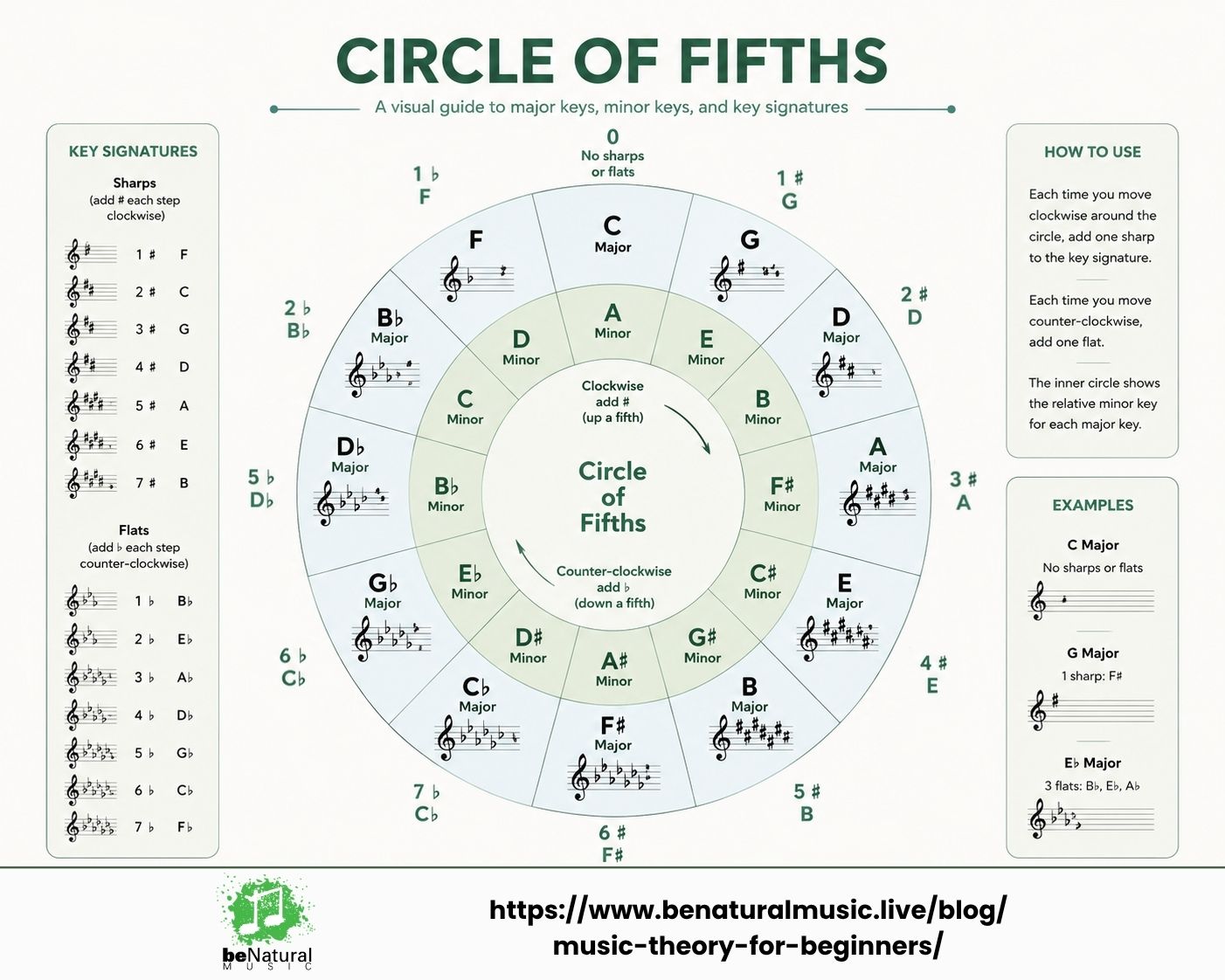
If you start on C and follow this pattern, you get the C Major scale: C, D, E, F, G, A, B, C (all white keys!). If you start on G, you must use an F-sharp (F#) to keep the pattern correct.
The natural minor scale has a different formula (W-H-W-W-H-W-W), giving it a darker, sadder sound. Interestingly, every major scale has a relative minor scale that shares the exact same notes but starts on a different note. For example, C Major and A Minor share the same notes!
To keep from writing sharps and flats next to every single note in a song, composers use a key signature at the beginning of the staff. The relationships between these keys are beautifully organized in a visual tool called the Circle of Fifths.
At Be Natural Music, we love showing students how to use these scales to create awesome solos, giving them a creative outlet to express themselves after a busy week of classes. For a deeper dive into applying these roadmaps, explore our guide on Patterns For Jazz Improvisation.
5. Chords and Harmony: Building Blocks of Songwriting and Collaboration
When you play three or more notes at the same time, you create a chord. The most basic chord is a triad, which is built by stacking thirds (playing a starting note, skipping a note, playing the next, skipping another, and playing the third).
There are four basic types of triads in music:
- Major Chords: Sound happy and bright (Root + Major Third + Perfect Fifth).
- Minor Chords: Sound sad or serious (Root + Minor Third + Perfect Fifth).
- Diminished Chords: Sound tense and spooky.
- Augmented Chords: Sound mysterious and floating.
When we string chords together, we create a chord progression. Musicians use Roman numerals (like I, IV, V, vi) to analyze these progressions. This allows us to easily transpose a song into any key!
In our classes, learning chords is a highly social experience. Students learn how their individual parts fit together to create a rich, unified sound, fostering teamwork and mutual support. To help your child get started on their instrument, check out our simple Beginners Guide To Piano Chords or explore color tones with our tutorial on Easy Jazz Chords Piano.
6. Rhythm, Meter, and Tempo: Finding the Groove and Relieving Stress
A beautiful melody is nothing without a groove to keep it moving. Rhythm is how music is organized across time.
- Tempo: The speed of the beat, measured in Beats Per Minute (BPM).
- Time Signature: Written as two numbers at the start of a song (like 4/4 or 3/4). The top number tells us how many beats are in each measure; the bottom number tells us what kind of note gets one beat.
- Note Values: How long a note is held (a whole note lasts for 4 beats, a half note for 2, and a quarter note for 1).
When we accent the “off-beats” instead of the main beats, we create syncopation, the bouncy, rhythmic secret behind jazz, rock, and reggae. For kids who spend hours sitting at desks or in front of screens, locking into a physical rhythm is an incredible way to release physical tension and clear the mind. Understanding how rhythm drives a song’s feel is the ultimate key to jamming. You can read more about how rhythm and melody intertwine during live jams in our article, What Is Improvisation In Jazz.
Are Music Lessons Worth It, and Why Do Parents Choose Be Natural Music?
Let’s be honest: raising a child in California is expensive, and your time is valuable. Between STEM tutoring, sports, and school prep, you have to ask: Are music lessons actually worth the money?
At Be Natural Music, we believe the answer is a resounding yes, but only if the lessons focus on the whole child. Under the direction of “yoga Matt,” our performance-first approach is designed specifically to meet the emotional, intellectual, and social needs of families:
- Intellectual Growth: Music theory isn’t just about notes; it’s about pattern recognition, mathematical relationships, and deep focus. Our students often find that the discipline and analytical skills they build here directly support their academic work at schools like Kennedy Middle or Cupertino High.
- Emotional Resilience: In a high-pressure environment like Cupertino or Santa Cruz, kids need a safe space to fail, try again, and express themselves without the fear of a bad grade. Our classes offer a nurturing environment where mistakes are celebrated as part of the creative process.
- Social Connection: Instead of practicing in isolation, our students join real jazz and rock ensembles. They learn to listen, collaborate, and build deep friendships with other local kids who share their passions. It’s a community where they truly belong.
We don’t teach music theory so kids can pass a test; we teach it so they can experience the joy of creating something real with their friends. If you’re ready to invest in your child’s confidence, creativity, and happiness, we’d love to welcome you to our South Bay musical family. Contact us today and find the perfect class to start your child’s musical journey!
