
Bass Guitar vs. Regular Guitar: How to Decide Which One to Learn First
- Why Does Choosing Between a Bass Guitar and a Regular Guitar Feel Like Such a Big Decision for Your Child?
- What Are the Physical, Technical, and Musical Differences Between Bass Guitar and Regular Guitar?
- Learning Curves: Which is Easier for Cupertino and Santa Cruz Beginners?
- Making the Choice: Bass Guitar vs Regular Guitar for Your Child
- Finding Your Child’s Groove in Cupertino and Santa Cruz
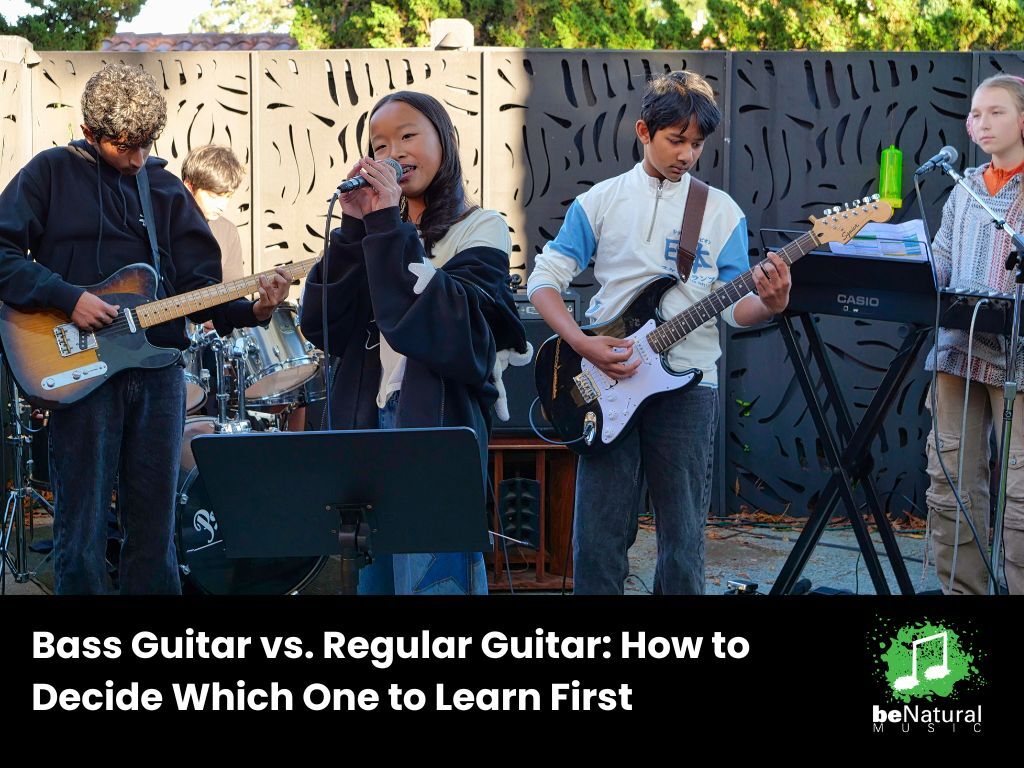
Why Does Choosing Between a Bass Guitar and a Regular Guitar Feel Like Such a Big Decision for Your Child?
Choosing the right instrument means finding the sound, role, and learning path that keep a student curious, confident, and excited to practice. Parents in Cupertino and Santa Cruz often worry about the same things: Will the instrument fit my child physically? Will lessons compete with school stress? Will they stay motivated long enough to feel successful? These are important questions, and they need clear answers before you invest time, energy, and money into music lessons.
At Be Natural Music, we help families turn that uncertainty into a confident first step. With performance-based guitar and bass instruction in Cupertino and Santa Cruz, our teachers look at your child’s personality, physical comfort, rhythm, and musical interests before recommending a path. Whether your child is drawn to the deep pulse of the bass or the expressive chords and melodies of a regular guitar, the right guidance can turn beginner nerves into real momentum, and that is why choosing intentionally matters.
| Bass Guitar | Regular Guitar | |
|---|---|---|
| Strings | 4 strings | 6 strings |
| Scale length | \~34 inches | \~24–25.5 inches |
| What you play | Single notes, rhythmic foundation | Chords, melody, solos |
| Role in a band | Rhythm section anchor | Harmonic and melodic lead |
| Initial learning curve | Gentler single notes first | Steeper chord shapes required |
| Ready to jam with others | \~3–6 months | \~6–12 months |
| Best for | Kids drawn to rhythm and groove | Kids drawn to melody and spotlights |
Both are excellent first instruments. The right choice depends on your child’s personality, physical fit, and musical goals, not which one is “easier.”
Choosing between a bass guitar or a regular guitar is one of the first big decisions a new musician faces, and for parents, it can feel surprisingly tricky. With our kids balancing rigorous school schedules, family activities, and screen-heavy routines, you might be wondering: Is music education actually worth the money and time?
At Be Natural Music, we believe the answer is a resounding yes. Beyond just learning notes, playing an instrument offers profound intellectual, emotional, and social benefits that act as the perfect counterweight to today’s intense, tech-driven lifestyle in both our Cupertino and Santa Cruz communities.
Think of it this way: in a band, the guitarist is one half: creating color, melody, and texture. The bassist is the wall, the other half: essential, structural, and powerful. Neither role is lesser. They’re just different.
This guide will walk you through the real differences between the two instruments, physically, musically, and practically, so you can make a confident, informed choice that supports your child’s personal growth.
I’m Matthew Pinck, founder of Be Natural Music and a jazz-trained guitarist with over 25 years of experience teaching both bass guitar and regular guitar to students of all ages in our Cupertino and Santa Cruz communities. I’ve watched hundreds of local students find their instrument, and I’m here to help your child find theirs.

What Are the Physical, Technical, and Musical Differences Between Bass Guitar and Regular Guitar?
To truly understand the choice between these two instruments, we have to look past the surface. While they share basic structural DNA, they operate on completely different frequencies.
According to a great breakdown titled How to Choose the Right Instrument for You, the differences go far beyond pitch. Because low frequencies require longer wavelengths to resonate, a bass is constructed to handle massive physical tension. This design directly impacts how a musician physically interacts with the instrument. Let’s break down the technical specifications:
| Feature | Bass Guitar | Regular Guitar |
|---|---|---|
| Standard Scale Length | 34 inches (Long scale) / 30 inches (Short scale) | 24 to 25.5 inches |
| Typical String Count | 4 strings (5- and 6-string options exist) | 6 strings (12-string options exist) |
| Standard Tuning | E-A-D-G (One octave lower than guitar) | E-A-D-G-B-E |
| Frequency Range | Low E is ~41 Hz (Deep, physical rumble) | Low E is ~82 Hz (Warm, mid-range) |
| Primary Technique | Index/middle finger plucking, slapping, muting | Flatpicking, strumming, multi-finger fingerstyle |
Because low frequencies can quickly become muddy and indistinct, bass players rarely play full, four-note chords. Instead, they focus on single-note lines that outline the harmony, while regular guitarists use polyphony (playing multiple notes at once) to build lush chordal textures.
How Is the Physical Anatomy of a Bass Guitar Different From a Regular Guitar?
The first thing your child will notice when holding a bass is its sheer size. A standard long-scale bass features a 34-inch scale length (the distance between the nut and the bridge), compared to a regular guitar’s comfortable 25.5-inch scale.

This longer neck means the frets on a bass are spaced much wider apart. For a younger child or a beginner with smaller hands, stretching across these frets can feel like a workout! Fortunately, short-scale basses (around 30 inches) exist and are a fantastic option for younger students in both Cupertino and Santa Cruz.
To understand how these parts interact, parents can explore our guide to the Parts Of A Guitar. Additionally, if you are wondering which size and model fits your child’s current physical development, our resource on What Guitar Should I Buy offers excellent advice on selecting the right starter gear.
Musical Roles: The Groove Machine vs. The Melodic Powerhouse
In our performance-focused ensembles in Cupertino and Santa Cruz, we emphasize that music is a team sport. The dynamic between a guitarist and a bassist is a perfect example of this collaboration, offering incredible benefits for kids who spend all day behind screens.
The regular guitar is a melodic powerhouse. Guitarists fill the mid-to-high frequency space, driving the song forward with recognizable riffs, strummed chord progressions, and expressive solos. If your child is constantly humming the vocal melody of a song or dreaming of taking center stage, regular Guitar Lessons will help them develop that melodic voice, serving to relieve academic stress.
On the flip side, the bass guitar is the ultimate groove machine. The bassist is the “sonic glue” of the band, bridging the gap between the drummer’s rhythm and the guitarist’s melody. By locking in with the kick drum, the bassist controls the room’s physical energy. Think of the deep, driving pulse in funk, reggae, or classic rock- that physical rumble that makes people want to dance- is entirely the bassist’s doing.
Whether performing on stage at a Cupertino community event, joining a Santa Cruz student showcase, or jamming at home, a band cannot function without a strong bass foundation. This teaches kids the value of teamwork and supporting others, a crucial social skill.
Learning Curves: Which is Easier for Cupertino and Santa Cruz Beginners?
It is a common belief that the bass is “easier” than the regular guitar because it only has four strings and mostly plays one note at a time. But is that really true? We dive deep into this topic in our article, Is Bass Easier Than Guitar? Let’s Settle the Debate.
The truth is, both instruments have unique learning curves that offer distinct intellectual benefits:
- The Bass Guitar (Gentle Start, Steep Climb): Because beginners start by playing single-note basslines rather than complex chord shapes, bass students can often join a simple band jam session within 3 to 6 months. However, the difficulty lies in timing and groove. A bassist must have metronomic rhythm. This builds incredible focus, discipline, and mathematical precision, skills that directly translate to academic success in students.
- The Regular Guitar (Steep Start, Gradual Climb): Regular guitar has a steeper initial hurdle. Beginners must build finger calluses and memorize complex finger shapes to play Guitar Chords For Beginners. It typically takes 6 to 12 months of consistent practice to comfortably transition between chords and strum in time. This process builds patience.
Regardless of the path chosen, learning How To Tune A Guitar (or bass) and developing ear training are the very first steps we teach to ensure a smooth, frustration-free start.
Making the Choice: Bass Guitar vs Regular Guitar for Your Child
When deciding which instrument to introduce to your child first, we recommend focusing on three main areas:
- Your Child’s Personality: Is your child drawn to the spotlight, or do they prefer supporting the team from behind the scenes? Guitarists often get the immediate attention, but great bassists are the respected leaders of the rhythm section. In the music industry, dedicated bass players are always in incredibly high demand.
- Their Physical Comfort: If your child is younger (under 8 years old), the thick strings and long neck of a standard bass might feel intimidating. Check out our guide on the Best Age To Start Guitar Lessons to see how age and physical development factor into the decision.
- What Their Ears Gravitate Toward: Put on their favorite songs while driving through Cupertino or Santa Cruz. What do they air-instrument to? Are they mimicking the screaming guitar solos, or are they tapping their feet to the driving bassline? Let their natural interest guide the way.
Finding Your Child’s Groove in Cupertino and Santa Cruz
At Be Natural Music, we believe that music education is one of the most rewarding investments you can make in your child’s emotional, academic, and social development. Under the guidance of “yoga Matt,” our community-focused school in Cupertino and Santa Cruz provides a warm, nurturing environment where local kids don’t just learn to read notes, they learn to create, collaborate, and express themselves.
When you invest in music lessons here, you aren’t just paying for weekly instruction. You are paying for an activity that relieves school-year anxiety, an intellectual workout that sharpens the mind, and a vibrant social circle where your child can collaborate with peers in real rock and jazz bands. Whether your family is near Cupertino’s tech corridor or Santa Cruz’s creative coastal community, bass and regular guitar lessons give students a hands-on way to build confidence, rhythm, and musical identity.
Still deciding between bass guitar vs. regular guitar for your child? Let Be Natural Music help you compare the feel, sound, learning curve, and band role of each instrument in a way that fits your child’s personality. Explore our personalized Bass Lessons and guitar programs in Cupertino and Santa Cruz, then contact us to schedule a first lesson and help your child discover which instrument feels natural.
