
Recitals, Concerts & Showcases: Where Your Kid Actually Gets to Perform
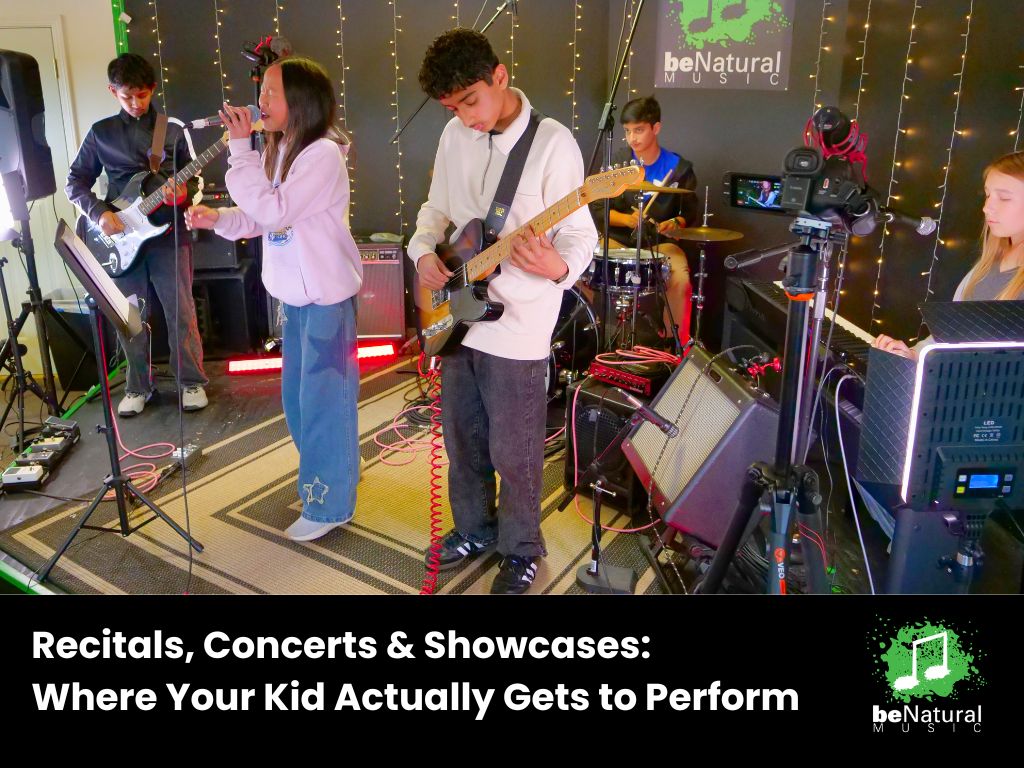
Why Does a Kids Music Stage Recital Feel So Exciting and So Nerve-Wracking at the Same Time?
Because it is not just a performance. It is the moment your child steps out of the practice room and discovers what it feels like to be heard. Parents often wonder: Will they freeze? Are they ready? What if they make a mistake? Those concerns are normal, and they are exactly why kids need safe, supportive stage experiences.
At Be Natural Music, a kids’ music stage recital is designed to help young musicians build confidence, not to put pressure on them. With the right preparation, encouragement, and performance setting, your child can turn nerves into growth and practice into something they are proud to share. Here is what to expect:
| Question | Quick Answer |
|---|---|
| What age can kids start performing? | As early as 4–5 years old in beginner showcases |
| How long does it take to reach the stage? | Most students are ready within 3–6 months of lessons |
| What formats exist? | School concerts, studio recitals, community showcases |
| Do kids need to be advanced? | No, beginners are encouraged to participate |
| What are the main benefits? | Confidence, focus, resilience, teamwork, and motivation |
There’s a moment every music parent in Cupertino knows. Your child has been practicing in the living room for months, maybe near the kitchen table while you’re making dinner after a long day at Apple Park or commuting down Highway 85. And then one day, they step onto a real stage, the lights come up, and something shifts. It’s not just about the song anymore. It’s about who they’re becoming.
In a high-achieving community like Cupertino, where the pressure on kids at schools like Murdock-Portal, Faria, or Lawson Middle School can be intense, parents often ask: Are music lessons actually worth the money and the time? With coding camps, math tutoring on Stevens Creek Boulevard, and competitive sports vying for your budget, does a music stage recital offer a real return on investment?
Research supports this: music practice and performance can support attention, memory, coordination, and emotional regulation. A review published through the National Institutes of Health found that musical training is linked with changes in brain structure and function. In plain English: getting on stage is not just cute. It helps kids grow.
But beyond the statistics, the real story is simpler: performing gives Cupertino kids a goal worth working toward—a creative sanctuary away from academic screens.
This guide is built specifically for Cupertino parents who want to understand the road from first lesson to first performance, and how to support their child every step of the way.
I’m Matthew Pinck, founder of Be Natural Music and a working musician and educator with over 25 years of experience helping South Bay kids find their voice through kids’ music stage recital experiences and live performance programs. If you’re wondering how long it takes, what to expect, and how to make the journey enjoyable rather than stressful, you’re in the right place.

What Is the Timeline for a Kids Music Stage Recital?
Every child’s musical journey is unique, but the path to the stage follows a predictable, rewarding progression. At Be Natural Music, we believe that performance shouldn’t be a distant, intimidating goal. Instead, we treat the stage as a natural extension of the classroom.
For a beginner starting private lessons or join-a-band classes, the timeline to their first music stage recital typically spans 3 to 6 months. This period allows them to build the foundational muscle memory, learn basic music theory, and polish a single piece to absolute comfort. Rather than waiting until they are “perfect,” we encourage kids to perform early. Getting on stage as a beginner teaches them that music is meant to be shared, not hoarded in a practice room.

As students advance, their goals evolve. An early intermediate student (9 to 18 months of experience) might focus on playing in an ensemble, matching their tempo with a drummer, or learning to improvise a short solo. No matter where your child is on this timeline, having a concrete performance date on the calendar transforms daily practice from a chore into a purposeful mission. To help them prepare for the spotlight, we share our favorite Stage Presence Tips early in the rehearsal process.
Why Performing on Stage Matters for Cupertino Kids: Is It Worth the Money?
Enrolling your child in music lessons is a significant investment of time and resources, especially in the Silicon Valley where extracurricular budgets are highly scrutinized. As Cupertino parents, we naturally look for activities that support our children’s intellectual, emotional, and social growth. A kids music recital is where that investment truly pays off, offering a unique return on investment that academic tutoring alone cannot match.
When a child performs, their brain undergoes an intense workout. Musical performance is one of the most cognitively demanding tasks a human can perform, requiring the simultaneous activation of the prefrontal cortex, auditory centers, motor networks, and emotional processing systems. This neural workout strengthens focus, enhances memory, and builds lasting cognitive capacity.
Research on music and the brain suggests that performance practice can help kids manage stress, focus attention, and turn nerves into confidence.
| Benefit Category | Specific Impact on Cupertino Kids | Real-World Application |
|---|---|---|
| Cognitive / Intellectual | Activates the prefrontal cortex; increases reading & math comprehension | Better focus during school exams and complex projects |
| Social / Collaborative | Teaches active listening, compromise, and shared responsibility | 2.5x higher likelihood of developing strong teamwork skills |
| Emotional / Personal | Earned confidence through overcoming stage fright; and anxiety reduction | Composure during public speaking and school presentations |
This holistic growth is why the local community highly values youth arts, from public school bands to local celebrations like the Summer Concert Series.
Where Can Kids Perform in School, Studio, and Community Recitals?
As you look for performance opportunities in the South Bay, you’ll find several different formats. Each offers a unique environment for young musicians:
- School Recitals & Concerts: Often large-scale ensemble performances (orchestra, band, or choir) at local schools like Monta Vista High or Cupertino High that teach kids how to blend into a massive group.
- Studio Showcases: Intimate settings, like the supportive environment we create at Be Natural Music, where the focus is on individual progress, self-expression, and personal milestones.
- Community Events: High-energy public stages, such as local festivals at Memorial Park or outdoor plazas near De Anza College, which give kids a taste of playing for a diverse, live crowd.
While some families explore traditional classical routes or local theater programs, Be Natural Music specializes in a unique, high-energy niche: Jazz, Rock, and Pop band dynamics.
Through our Kids Music Classes and our famous Kids Rock Out: Be Natural Teen Bands, we make sure that every student, regardless of skill level, finds a safe and welcoming space to shine.
The 7-Week Timeline to a Kids Music Stage Recital
To ensure your child feels prepared and excited rather than overwhelmed, we recommend a structured 7-week preparation timeline. This method is designed to build “earned confidence” step-by-step:
- Weeks 7–6: Song Selection & The “2-Minute Rule.” Select a piece that the child can play comfortably. We highly recommend trimming recital pieces to a tight 2 minutes (a 30-second intro, 60 to 75 seconds of the core melody, and a 15-second clean ending and bow). Short, polished pieces sound incredibly professional and keep the audience engaged.
- Weeks 5–4: “Mix-It-Up” Practice. To prevent kids from relying solely on fragile muscle memory, have them insert their recital piece randomly between other daily tasks. This simulates the “cold start” condition of stepping onto a stage.
- Week 3: On-Stage Simulation. Practice the entire walk-on routine at home. Have your child walk into the room, adjust their music stand, take a deep breath, count one silent bar to set their tempo, play, let the final note ring out for 2-3 times its value, and bow.
- Week 2: Instrument & Logistics Check. Put fresh strings on guitars, check drumsticks, and review the wardrobe. We outline these specific logistics in our seasonal updates Regarding Spring Concerts.
- Week 1: The Dress Rehearsal. Perform the song in front of stuffed animals, family members, or neighbors to normalize the feeling of being watched.
By breaking the preparation down, you easily avoid common recital pitfalls—such as starting the song too fast due to adrenaline, or stopping abruptly on the very last note.
Overcoming Stage Fright and Managing Recital Day Nerves
It is completely normal for a child to feel butterflies before a performance. In fact, learning to manage those butterflies is one of the greatest life lessons the stage can teach.
To help your child navigate recital day nerves, try these practical steps:
- Normalize the Feelings: Remind them that even professional musicians get nervous. Adrenaline is just the body’s way of getting ready to do something amazing!
- Deep Breathing: Have them take three slow, deep “balloon breaths” backstage to calm their heart rate.
- Focus on the Gift: Remind them that performing is not a test; it is a gift they are giving to the audience.
- Arrive Early: Ensure you arrive at least 10 to 15 minutes before the designated call time so your child has time to tune their instrument, acclimate to the room, and settle in.
- Respectful Audience Etiquette: Lead by example. Encourage polite applause, silence all cell phones, and remain for the entire showcase to support every performer on the bill. You can find detailed schedules and venue guidelines on our Upcoming Events page.
Raising the Curtain on Your Child’s Musical Future
At its core, a kids music stage recital is a celebration of effort, patience, and growth. For Cupertino families, it is a moment where our local community comes together to say, “We see how hard you’ve worked, and we are proud of you.” Long after the last note fades, the resilience, focus, and self-belief your child developed on that stage will stay with them, helping them succeed in school, sports, and life.
Join the Band: Your Child’s Next Music Recital
If you are ready to watch your child build real, lasting confidence through the joy of music, we would love to welcome you to our community. Guided by “yoga Matt” and our supportive team of instructors, Be Natural Music offers a safe, optimistic, and encouraging environment where your child can explore their creative potential.
Whether they want to strum their first chord or front a rock band, we are here to guide them every step of the way. Register for Kids Music Classes today, and let’s get your child ready for their moment in the spotlight!
